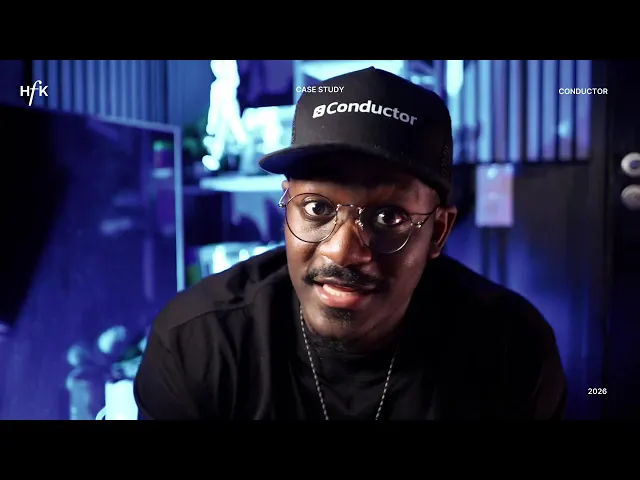
Conductor

Conductor

Conductor

Rethinking Time Management by Starting With the Wrong Question

Rethinking Time Management by Starting With the Wrong Question

Product Design

Experience Design

Product Management

VeraPax Tech

VeraPax Tech

Creating the world's first end to end time intelligence platform for professionals

Creating the world's first end to end time intelligence platform for professionals

People often describe Conductor as an AI calendar. I don't.

Because calendars aren't actually the problem.

They're just where the symptoms show up.

Client

VeraPax Tech

Scope

Product Design,

Product Management

Year

2026

Duration

6 months

The core problem

The core problem

We know how to track time, but have no idea how to understand what time does for us

We know how to track time, but have no idea how to understand what time does for us

We know how to track time, but have no idea how to understand what time does for us

Conductor began because I couldn't stop noticing something strange about the software we use every day.

Businesses have systems for managing almost every valuable resource.


Money has financial software.

People have HR software.

Projects have project management tools.

Customers have CRMs.

Knowledge has documentation platforms.


But time, arguably the one resource that affects all the others, is mostly managed through calendars.

And calendars don't really manage time. They store appointments. That difference sounds small. I don't think it is.

The scheduling industry has spent years trying to answer one question.


"When are you available?"


At first glance, it seems reasonable. Find an empty slot. Book the meeting. Move on.


But the more I thought about it, the more I realised availability is an incredibly poor signal for whether something should happen.


An empty hour isn't necessarily a good hour. A meeting isn't valuable simply because it found space on a calendar. And someone requesting your time doesn't automatically deserve it.


We had collectively accepted a model that optimised for convenience instead of outcomes. I became much more interested in a different question. What if software managed your capability instead of your availability?


That question became Conductor.

The accepted assumption

The accepted assumption

People believe that as long as you can find time to handle or delegate meetings, you are in control of your time. Or what it does to your life.

People believe that as long as you can find time to handle or delegate meetings, you are in control of your time. Or what it does to your life.

The first undertakings

The first undertakings

Before Designing Anything, I Needed a Different Mental Model

Before Designing Anything, I Needed a Different Mental Model

I have a habit whenever I begin designing products.


I stop thinking about interfaces.

I start thinking about decisions.


Interfaces eventually disappear.

Decisions don't.


So instead of asking what pages Conductor needed...


I asked what decisions people repeatedly make around time.


They usually look something like this.

  • Should I take this meeting?

  • If I do...

  • When should it happen?

  • Did anything valuable come out of it?

  • Was it worth the time it consumed?

  • And is the way I'm spending time actually moving me toward my goals?


Those became the product.

Not features, decisions.

Everything else followed naturally.

Access Before Availability

Access Before Availability

Most scheduling software immediately exposes your calendar.

Most scheduling software immediately exposes your calendar.

Conductor intentionally doesn't.

Because scheduling is actually the second decision.

The first decision is whether someone deserves access to your time.

So I introduced an Access Intelligence layer.

Instead of immediately showing availability, guests first explain why they want to meet.


Conductor intentionally doesn't.

Because scheduling is actually the second decision.

The first decision is whether someone deserves access to your time.

So I introduced an Access Intelligence layer.

Instead of immediately showing availability, guests first explain why they want to meet.


Clearing the philosophy

Clearing the philosophy

Capability Matters More Than Availability

Capability Matters More Than Availability

This was probably the biggest philosophical shift in the product.

Traditional calendars assume every available hour has equal value.


Real life clearly doesn't.

Most people know when they're strongest.

Some people think best early in the morning.

Others become highly creative late at night.


Some perform brilliantly in conversations but struggle with deep work after multiple meetings.

Yet scheduling software ignores all of it.

So Conductor learns something calendars never cared about.


Energy.

The meeting journey

The meeting journey

Meetings Shouldn't End When The Call Ends

Meetings Shouldn't End When The Call Ends

Most meetings just:

  • Record it.

  • Transcribe it.

  • Summarise it.

  • Done.


That never felt particularly useful to me.

Because meetings consume time.

Time should create value.

So I started looking beyond transcription.


  • What actually changed because forty-five minutes happened?

  • What decisions were made?

  • What commitments were created?

  • Which goals moved forward?

  • Which meetings consistently produce nothing?

  • Which conversations repeatedly consume your best hours while producing little progress?


Those questions became the foundation of Meeting Intelligence.


One thing I noticed while studying AI products was that intelligence often becomes a destination.

There's usually an AI button somewhere.

Users are expected to remember it's there.

Open it.

Ask a clever question.

Hope it helps.

I wanted something different.

Intelligence should feel infrastructural.

It should quietly improve every interaction.


The user shouldn't think,

"I should use AI."

They should simply feel that the product understands them.

I got a very clear understanding

I got a very clear understanding

Intelligence Isn't Another Feature

Intelligence Isn't Another Feature

The secret DNA

The secret DNA

Connecting Behaviour to Goals

Connecting Behaviour to Goals

This eventually became the part of Conductor I cared about most.

Most productivity software measures activity.


They're behavioural insights.

And behaviour is ultimately what determines outcomes.

This eventually became the part of Conductor I cared about most.

Most productivity software measures activity.


They're behavioural insights.

And behaviour is ultimately what determines outcomes.

Conclusion

Conclusion

Reflecting on the project

Reflecting on the project

Conductor reminded me why I enjoy product design.


I don't enjoy making interfaces.

I enjoy changing the model underneath them.


Good products rarely come from prettier screens.

They come from better questions.


Calendars asked,

"When are you free?"


Conductor asks,

"When are you capable?"


That single question changed the architecture of the product, the user experience, and ultimately what the software is trying to achieve.

It's a reminder that the most valuable design work usually happens long before the first wireframe is drawn.